
Taking care of your teeth goes way beyond what you can see when you look in the bathroom mirror. Many of the most common oral health issues, like tiny cavities hiding between teeth, bone loss around gums, or hidden infections deep near the roots, develop quietly out of sight.
A physical exam tells your dentist a lot about the surface of your enamel and the condition of your soft tissues. However, a huge portion of your tooth structure and supporting bone sits beneath your gumline.
Dental X-rays act as a diagnostic roadmap, giving your dentist a clear look inside and between your teeth. They play a vital role in:
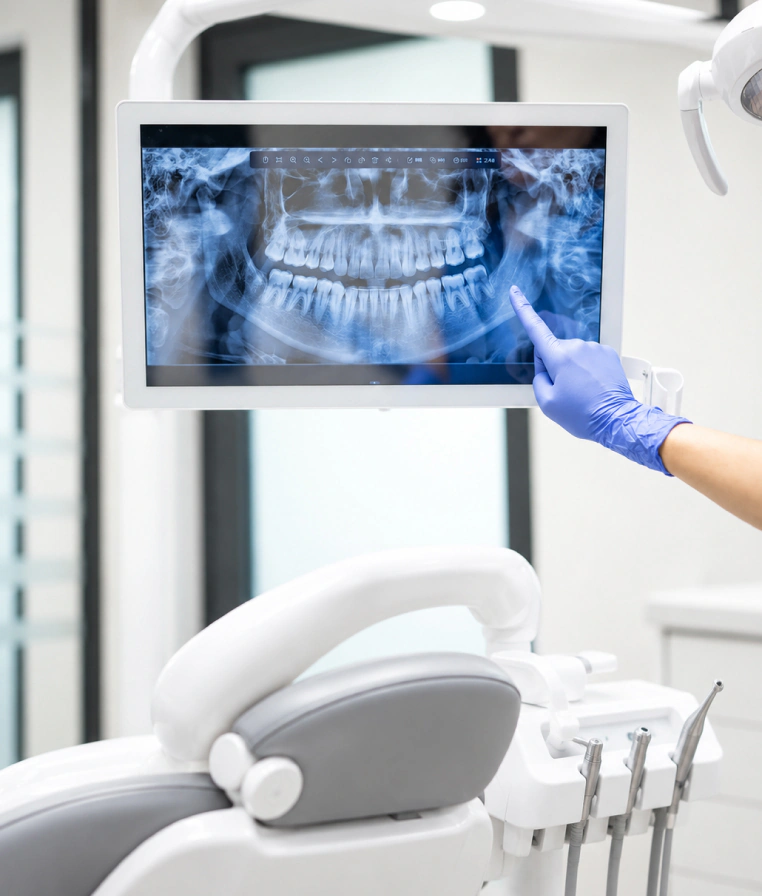
Depending on your overall health background, age, and specific dental needs, your dentist will recommend specific types of imaging to get the clearest possible view.
Bitewing X-rays are the most common diagnostic images taken during routine checkups.
What They Show: Detailed views of the upper and lower teeth in a specific area of your mouth, from the crown down to the supporting bone level.
When They Are Used: Perfect for detecting decay forming between teeth and measuring subtle changes in bone density caused by gum disease.
While bitewings focus on the crowns of several teeth, periapical X-rays zoom in on one or two full teeth from top to bottom.
What They Show: The entire tooth structure, including the tip of the root and the surrounding bone tissue.
When They Are Used: Helpful for investigating toothaches, tracking deep infections, or evaluating teeth before performing endodontic care.
Panoramic imaging captures a broad, sweeping view of your entire mouth in a single image.
What They Show: All your upper and lower teeth, jaw joints, nasal passages, and sinus cavities.
When They Are Used: Ideal for evaluating impacted wisdom teeth, assessing jaw pain or TMJ issues, and planning comprehensive surgical or orthodontic care.
Dental technology has come a long way over the last few decades. Today, digital X-rays have almost entirely replaced traditional film imaging, making your visits faster, more comfortable, and much safer.
Key benefits of modern digital imaging include:
It is completely normal to have questions about safety whenever radiation is mentioned. The reality is that digital dental X-rays deliver extremely low exposure levels. In fact, a standard set of four bitewing X-rays exposes you to about the same amount of background radiation you naturally absorb from the environment during a typical day outside.
Your safety remains a top priority during every imaging session. Standard precautions include:
There is no one-size-fits-all schedule for dental imaging. How often you need X-rays depends heavily on your overall oral health, your history of decay, and your current symptoms.
Montvale offers a wonderful quality of life with its quiet neighborhood streets, top rated schools, and close knit community spirit. Staying on top of your family’s health needs should be just as easy and stress free.
Located just a short drive away, All Dental Solutions NJ welcomes friendly, patient focused care to individuals and families from Montvale and nearby Bergen County towns. Our practice combines advanced digital imaging tools with a warm, gentle approach so you always understand your care and feel comfortable in the chair.
If you are due for a routine checkup or want to address a tooth concern before it worsens, contact All Dental Solutions NJ today. Our team is here to answer your questions, walk you through our safety protocols, and help you keep your smile healthy for years to come.
Q: Are dental X-rays safe during pregnancy?
A: Modern digital X-rays carry very low radiation. However, unless you are dealing with an urgent dental issue or infection, routine elective X-rays can often be postponed until after your baby arrives. Always let your dental team know if you are pregnant or suspect you might be.
Q: Do dental X-rays hurt?
A: Not at all. Taking digital X-rays is completely painless. You simply bite down gently on a small, smooth digital sensor covered in a soft protective sleeve for a few seconds while the image is captured.
Q: Why do I need X-rays if my teeth feel completely fine?
A: Many common dental issues, such as early-stage decay between teeth or mild bone loss, develop without causing any pain at first. By the time a tooth starts hurting, the problem has usually progressed. X-rays help your dentist catch these issues early when treatment is simpler and more conservative.
Q: Can I refuse dental X-rays during my checkup?
A: You always have the right to accept or decline any medical procedure. However, because dentists cannot safely diagnose issues beneath the enamel or gums without visual data, refusing necessary X-rays may limit your dentist’s ability to provide complete care or clear you for certain treatments.