
Maintaining a healthy, vibrant smile involves far more than brushing and flossing at home. While daily habits keep the surfaces of your teeth clean, many significant oral health concerns develop beneath the gumline or inside the tooth structure where they cannot be seen during a standard visual exam.
A visual examination provides valuable information about your gums and the outer enamel of your teeth. However, a major portion of your tooth structure, along with the supporting jawbone, remains hidden from sight.
Digital radiography helps bridge this gap by providing high-resolution images of internal structures. These diagnostic scans assist in:
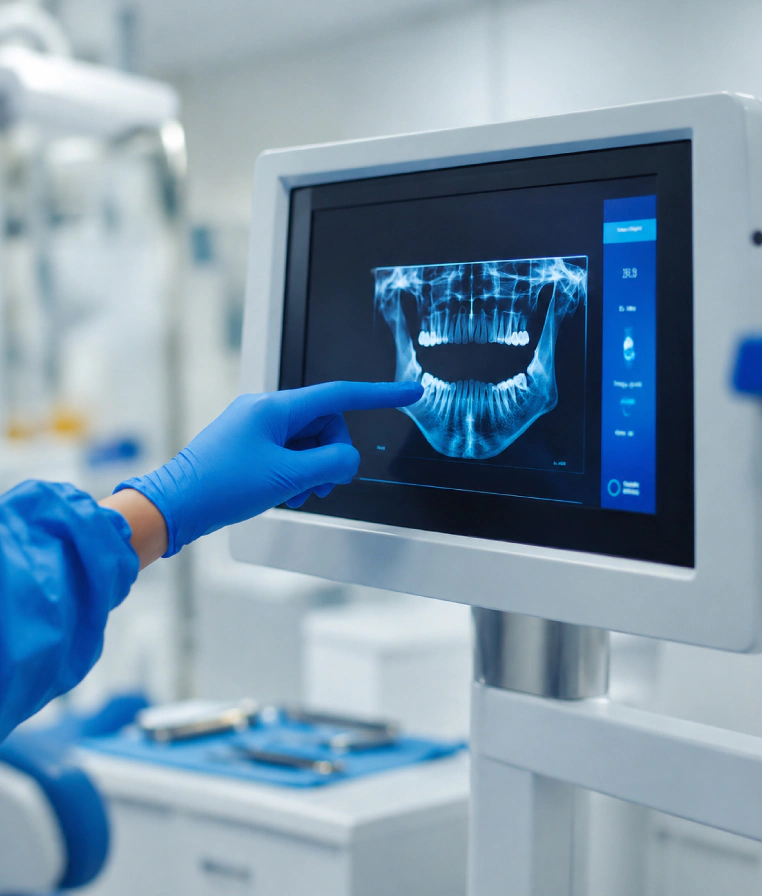
Different oral health evaluations call for different types of diagnostic imaging. Depending on your symptoms, age, and dental history, specific X-ray views may be recommended.
Bitewing X-rays focus on the upper and lower back teeth in a single section of the mouth.
Primary Focus: These scans reveal the crowns of the teeth down to the level of the supporting bone.
Clinical Purpose: They are ideal for detecting decay between back teeth and monitoring subtle bone level changes related to gum health.
Periapical scans highlight one or two specific teeth in complete detail from top to bottom.
Primary Focus: The image captures the entire tooth, extending from the biting surface past the root tip into the jawbone.
Clinical Purpose: Dentists use these images to investigate localized tooth pain, plan endodontic therapy, or evaluate deep infections.
Panoramic radiography creates a wide, continuous view of your entire oral cavity.
Primary Focus: It displays all upper and lower teeth, the jawbones, temporal joints, and sinus passages in one continuous image.
Clinical Purpose: This format is particularly useful for planning orthodontic care, evaluating wisdom teeth, and reviewing jaw alignment.
Dental imaging has evolved significantly over recent years. Today, digital X-rays have largely replaced traditional film, offering a faster, safer, and more detailed experience for patients.
Key advantages of digital imaging include:
It is natural to have questions regarding safety whenever imaging equipment is mentioned. Modern digital dental X-rays utilize extremely low doses of radiation. In context, the amount of exposure from a standard set of diagnostic bitewings is comparable to the natural background radiation a person absorbs during a short outdoors trip or a brief domestic flight.
To ensure patient safety, standard protective steps are always followed:
At All Dental Solutions NJ in Park Ridge, we use the Vatech EzRay Air handheld dental X-ray unit, which features built-in radiation shielding designed to enhance operator safety.
The Vatech EzRay Air incorporates two layers of protection:
How often you need dental X-rays depends on your current oral health, age, risk factors, and dental history. There is no rigid, one size fits all schedule.
River Vale is known for its peaceful suburban atmosphere, excellent parks, and strong community feel. Having reliable, high-quality healthcare nearby makes maintaining your family’s routine wellness simple and convenient.
Located just a short drive away, All Dental Solutions NJ provides comprehensive, patient-centered care for individuals and families throughout River Vale and Bergen County. Our team utilizes modern digital imaging technology alongside a comfortable, compassionate approach to ensure you receive clear answers and personalized care at every visit.
If you are due for a routine dental checkup or have questions about your oral health, contact All Dental Solutions NJ today. Our welcoming team is available to guide you through our diagnostic procedures, address your concerns, and help you maintain a healthy smile.
Q: Are digital dental X-rays safe during pregnancy?
A: Digital X-rays involve very low radiation levels. However, non-urgent elective imaging is often postponed until after delivery unless an active infection or dental emergency requires immediate diagnosis. Always notify your dental team if you are pregnant or think you might be.
Q: Will taking dental X-rays cause any discomfort?
A: No, taking digital X-rays is completely painless. You simply bite down gently on a small, cushioned sensor for a few seconds while the image is captured.
Q: Why are X-rays necessary if my teeth look fine?
A: Many underlying issues, including early decay between teeth and bone deterioration, develop without pain or visible symptoms. X-rays allow your dentist to spot these hidden concerns early, preventing more extensive treatments later on.
Q: Can I opt out of dental X-rays during a routine checkup?
A: Patients always maintain the right to accept or decline medical recommendations. However, because dentists cannot evaluate internal tooth structures or bone health visually, foregoing necessary images may restrict your provider’s ability to diagnose problems accurately or proceed with certain treatments.
Q: How quickly can I review my X-ray results?
A: Digital images appear on the treatment room monitor almost instantly. Your dentist can walk you through the scans, highlight key details, and discuss any recommendations during your appointment.